
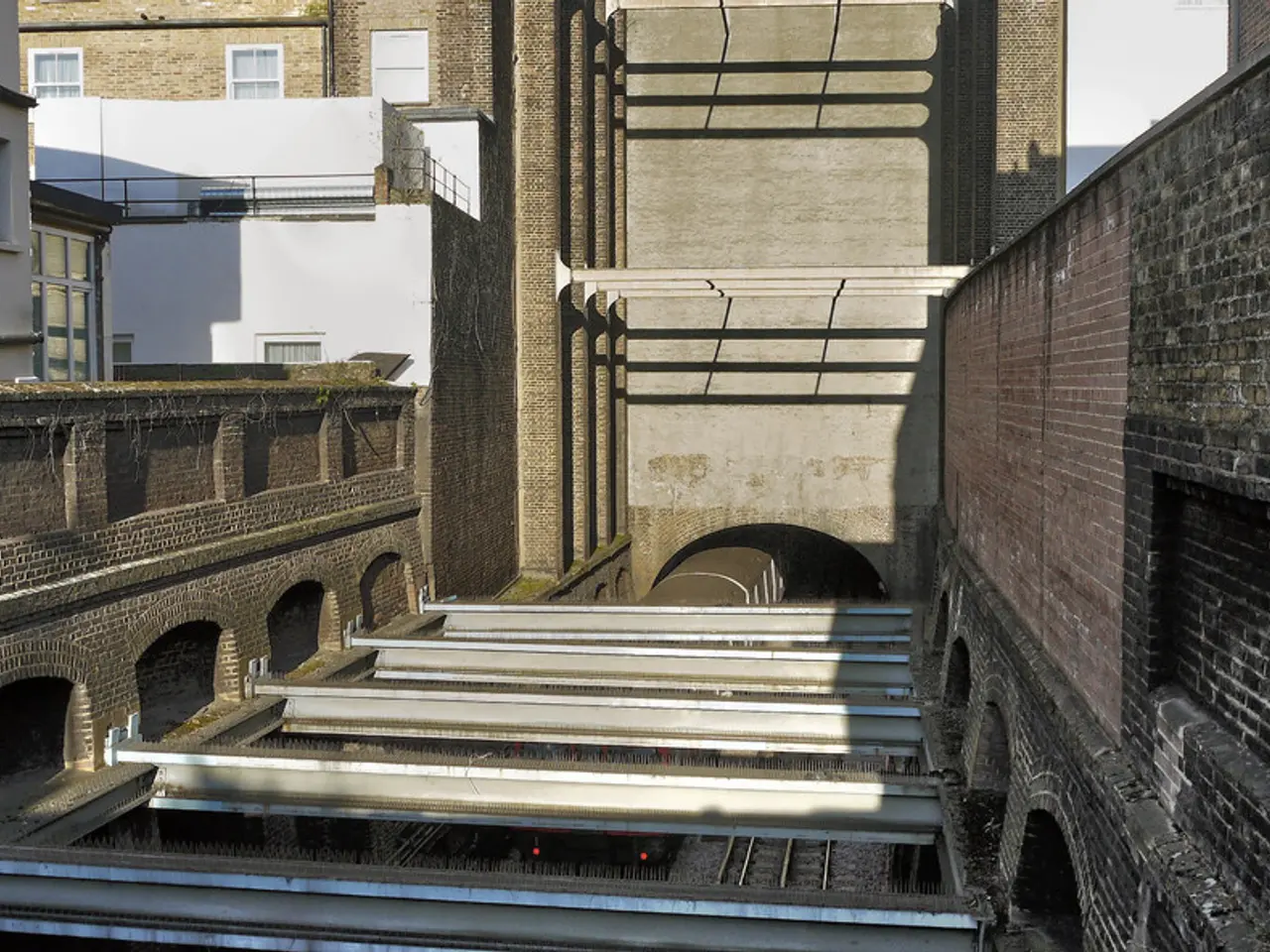
The Elizabeth Line clinches the 2024 RIBA Stirling Prize, recognized for its architectural excellence
In May 2022, the Elizabeth Line, a major new railway in London, was officially opened, marking a significant milestone in the modern expansion and integration of the city's rail network. This ambitious project, part of over 150 years of railway development in London, dating back to the Metropolitan Railway in 1863, has been designed to significantly increase rail capacity and reduce cross-London journey times.
The Elizabeth Line, formerly known as Crossrail, was conceived to address the growing need for greater rail capacity and faster travel across London, complementing the existing London Underground and Overground services. The line integrates new and existing infrastructure, representing one of the most complex and ambitious transport projects in recent UK history.
During the construction of the Elizabeth Line, extensive archaeological excavations were conducted, uncovering significant historic artifacts and remains. These finds have provided insights into London's long history, including Roman and medieval periods beneath the city. Such discoveries have been carefully documented and preserved, linking the modern infrastructure project with London's rich archaeological heritage.
The line features state-of-the-art design, including high-capacity trains and spacious, modern stations. Stations are designed with accessibility in mind, featuring step-free access, clear signage, and passenger amenities to enhance the travel experience. The tunnels and platforms are built to accommodate longer trains and high-frequency services, enabling the line to handle up to 200 million passengers annually.
The Elizabeth Line has transformed London's transport network by providing faster, more direct routes across the city, reducing travel times and relieving congestion on other London services. It connects key transport hubs and financial districts, boosting economic activity and accessibility. Beyond transportation, the line has been a catalyst for urban regeneration, particularly in areas surrounding new and upgraded stations. This has led to new housing, commercial developments, and public spaces, contributing to London's growth and modernization.
The improved connectivity has increased property values and spurred investment in areas previously less accessible by public transport. The Elizabeth Line has ten new stations: Paddington, Bond Street, Tottenham Court Road, Farringdon, Liverpool Street, Whitechapel, Canary Wharf, Custom House, Woolwich, and Abbey Wood.
The Elizabeth Line's design offers a slick suite of architectural components, creating a consistent line-wide identity. The line's lighting subtly adapts between warm and cool tones, highlighting different levels and transitions. The stations provide a calming refuge with perforated cladding, refined lighting, and an intuitive wayfinding system.
The Elizabeth Line's double-length platforms are built to accommodate full-size trains, and step-free access is standard throughout. The line's excavation effort formed part of the largest archaeological dig in British history, yielding an extraordinary array of artefacts. The winner of the RIBA Stirling Prize for the Elizabeth Line was announced at a ceremony on 16 October at London's Roundhouse.
The Elizabeth Line project is a recognition of the challenges that the design profession faces today, including the responsibility to rapidly respond to the climate emergency, decarbonize cities, and prioritize social and economic equity. The project was chaired by Muyiwa Oki, RIBA president, with a jury consisting of Alex Ely, Mary Duggan, Yana Peel, Minna Sunikka-Blank, and David Light. The project's design team includes Grimshaw, Atkins Realis, Equation, and Maynard.
In the 2024 RIBA Stirling Prize competition, the Elizabeth Line project saw off competition from Allies and Morrison, Al-Jawad Pike, Clementine Blakemore Architects, Jamie Fobert Architects, and Mikhail Riches. Neill McClements, Partner at Grimshaw, highlighted the transformative impact of the Elizabeth Line on London's transport network and people's lives, stating that descending into the Elizabeth Line's tunnels feels like entering a portal to the future, transforming the typical commuter chaos into an effortless experience.
In summary, the Elizabeth Line is a landmark infrastructure project with deep historical roots, thoughtful integration of archaeological heritage, cutting-edge design, and a profound impact on London's transportation and urban landscape.
- The historical archaeological excavations during the construction of the Elizabeth Line provided insights into London's long history, highlighting the integration of modern infrastructure with the city's rich archaeological heritage.
- The Elizabeth Line project, beyond transportation, has been a catalyst for urban regeneration, contributing to London's growth and modernization by spurring new housing, commercial developments, and public spaces in previously less accessible areas.
- The Elizabeth Line project, a winner of the RIBA Stirling Prize for architecture in 2022, embodies the challenges faced by the design profession today, emphasizing the need for rapid responses to the climate emergency, decarbonization, and prioritizing social and economic equity.




